
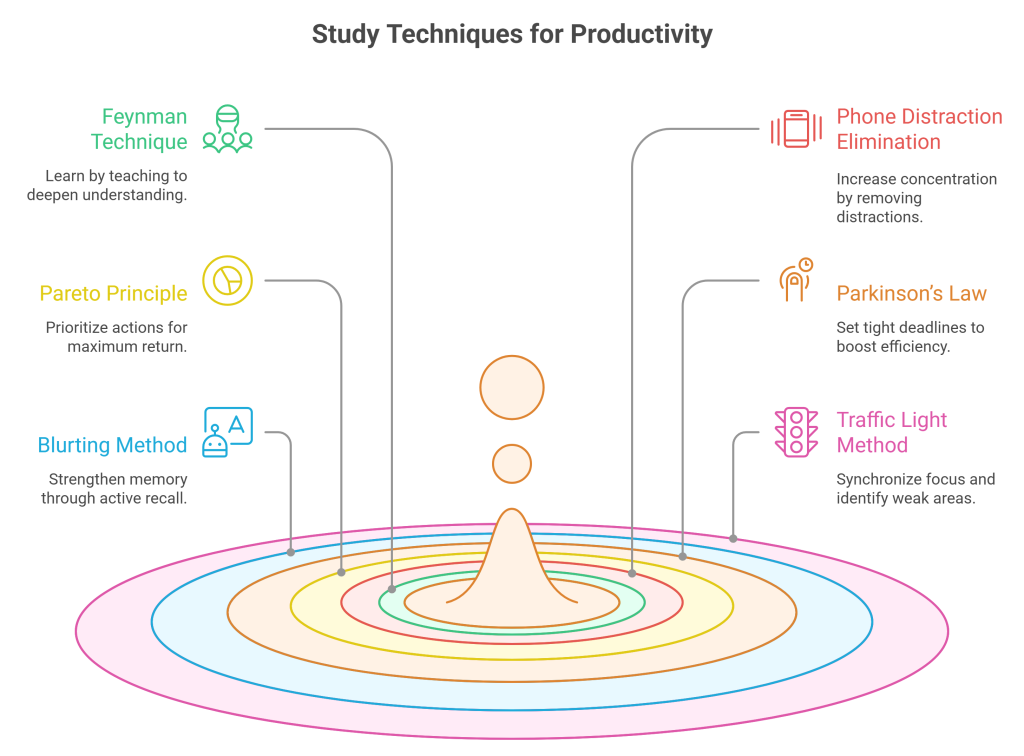
Under pressure to study or sidetracked by your phone? These 6 strategies have been crafted to help you work smarter, not harder. They’re backed by psychological concepts and used by top students globally. Let’s discover each of them and the way they can improve your productivity and study results.
Techniques Overview
Below, we break down each method, what it accomplishes, and why it’s effective. We’ve included comments from recent research to ensure you in their utilization.
Feynman Technique: Learn by teaching, ideal for deep understanding.
Put Your Phone Away: Eliminate distractions for increased concentration, backed up by research on screen interruptions.
Pareto Principle (80/20 Rule): Prioritize actions that deliver maximum return, a widely proven time management strategy.
Parkinson’s Law:Set tight deadlines to increase efficiency, reducing procrastination.
Blurting Method: Use active recall to strengthen memory, supported by cognitive research.
Traffic Light Method: Utilize self-test to synchronize study focus, and identify weak areas
For more details, check out supporting research at Feynman Technique Research, Digital Distractions Impact, and others listed at the end.
In-Depth Analysis of Each Study Technique
Each technique below includes a description, how it works, supporting evidence, and a practical example to help you apply it effectively.
Feynman Technique
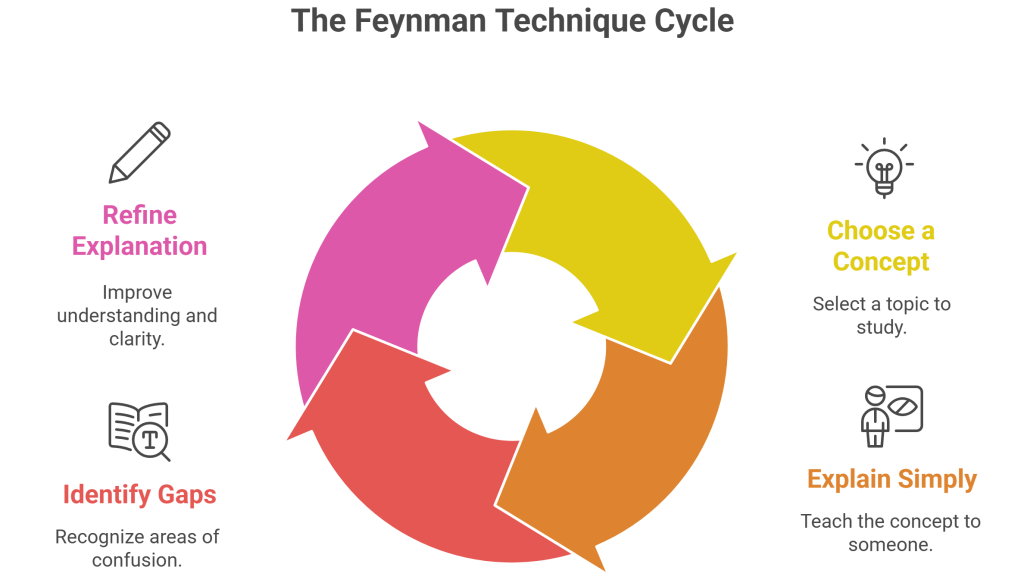
Description: The Feynman Technique involves picking a concept, explaining it in simple terms as if teaching a 12-year-old, identifying gaps in understanding, and refining your explanation. It’s ideal for deep learning, simplifying complex ideas, and spotting knowledge gaps.
How It Works: This method uses active recall and metacognition, forcing you to break down concepts into clear, digestible parts. By teaching, you reinforce your understanding and uncover areas needing review.
Evidence: Named after Nobel Prize-winning physicist Richard Feynman, this technique is widely praised in education. A 2023 report from InnovationTraining.org highlights its roots in cognitive psychology, showing that active learning boosts retention by up to 50%. According to fs.blog, it’s effective for mastering complex subjects like physics or math.
Example: To study calculus, explain the concept of derivatives as “measuring how fast something changes” to a friend. If you struggle to simplify terms like “limit,” revisit those areas and practice again.
Put Your Phone Away Technique
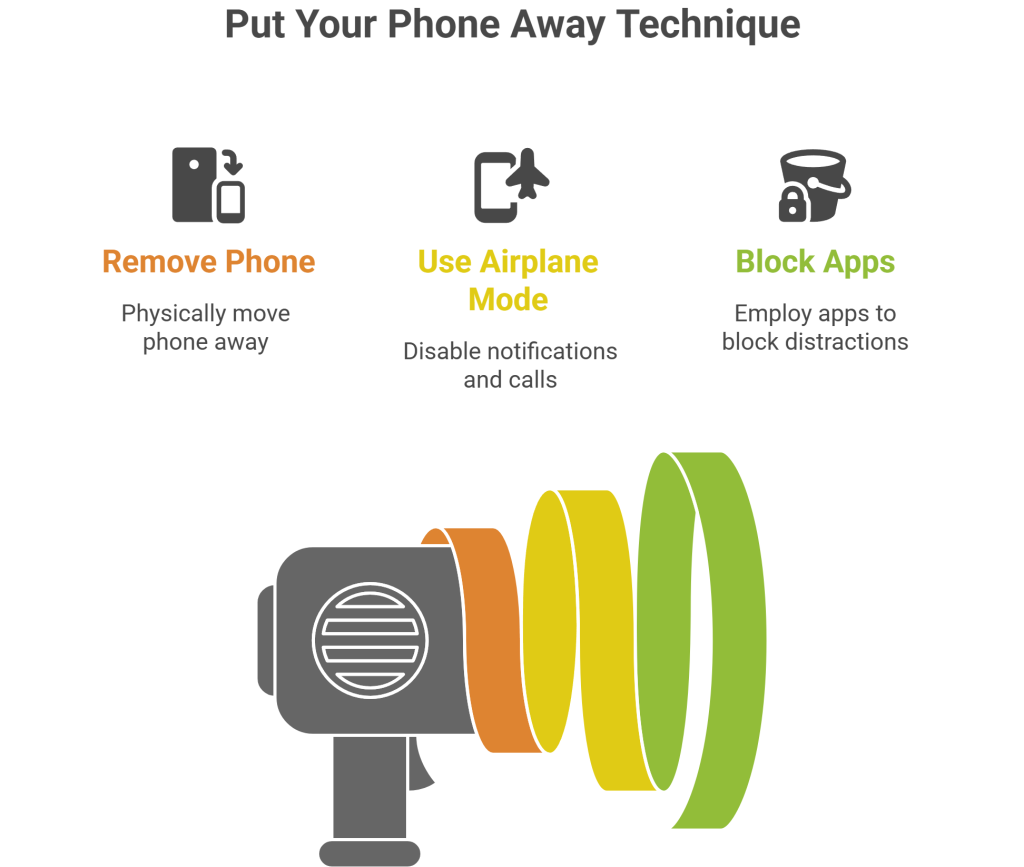
Description: Physically remove your phone from your study space, use Airplane Mode, or employ apps like Forest or Freedom to block distractions. This technique is perfect for improving focus, reducing procrastination, and creating a distraction-free environment.
How It Works: Eliminating digital distractions minimizes interruptions, which research shows disrupt focus. A 2024 Vorecol.com study found employees lose 2.1 hours daily to distractions, while a University of California, Irvine study notes it takes 23 minutes to refocus after an interruption. Social media notifications also trigger dopamine spikes, reducing motivation (Harvard Health, 2020).
Evidence: The Society for Human Resource Management (SHRM) estimates distractions cost $10,000 per employee annually in lost productivity. Apps like Forest and Freedom are proven tools for maintaining focus.
Example: Before studying, place your phone in another room and set a 25-minute Pomodoro timer using the Forest app. Reward yourself with a 5-minute break after each session.
Pareto Principle (80/20 Rule)
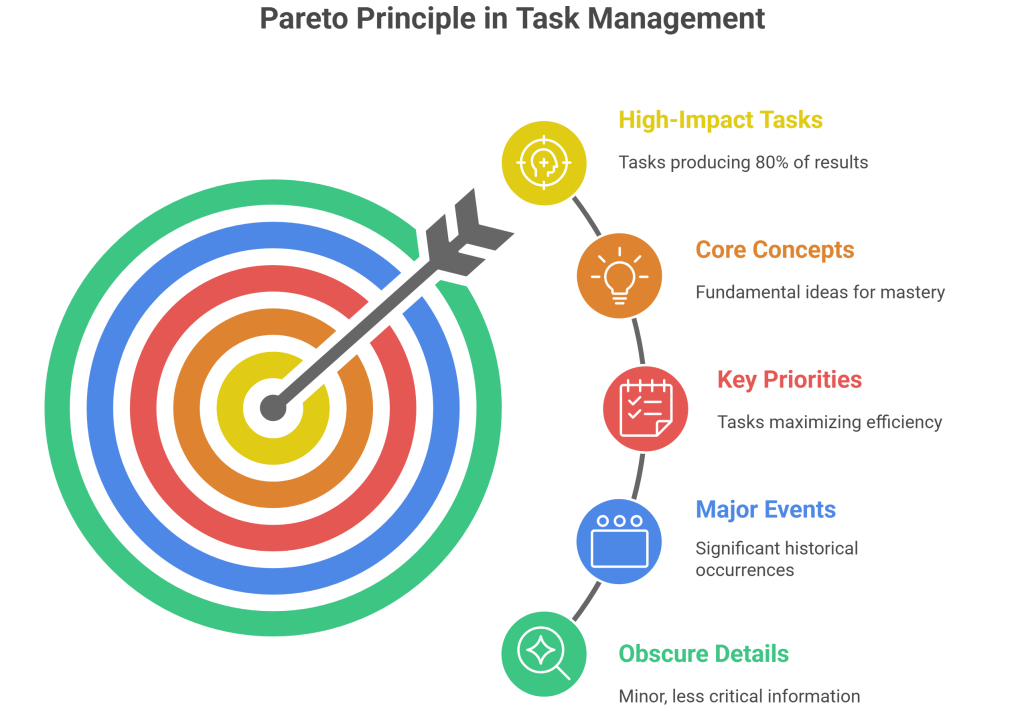
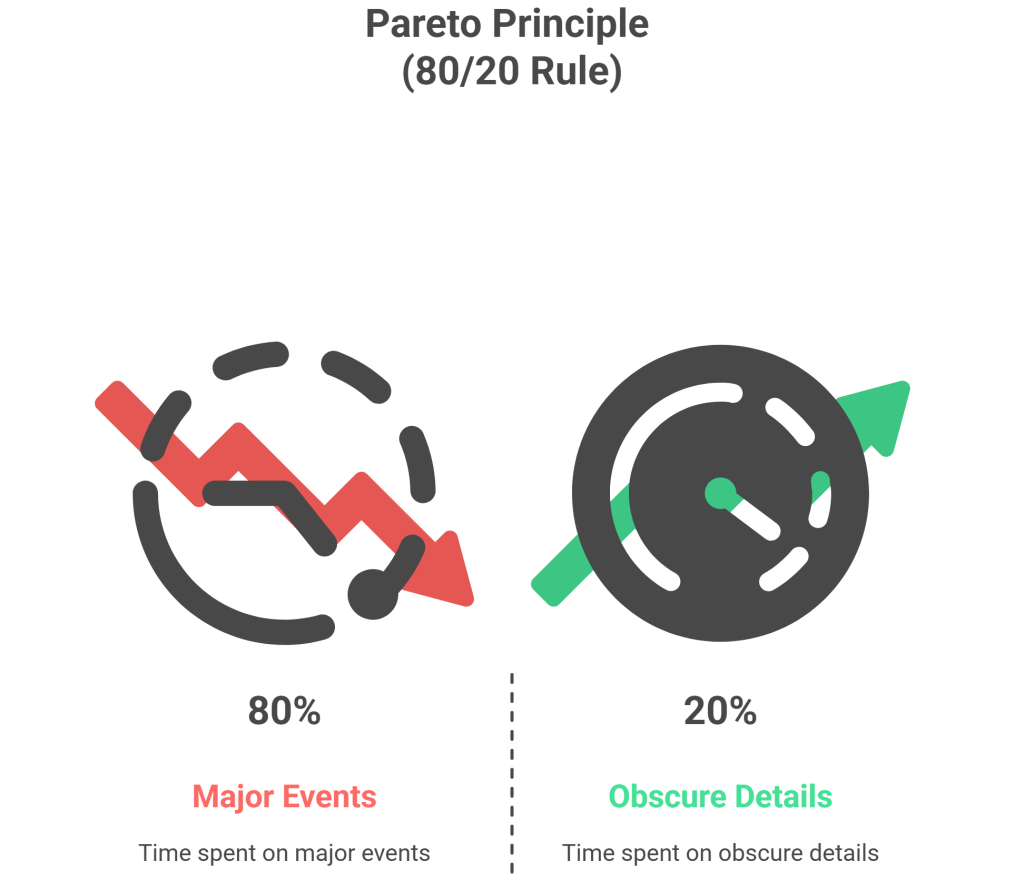
Description: Focus on the 20% of tasks that produce 80% of your results, such as mastering core concepts or prioritizing high-weighted assignments. This technique is great for time management, prioritization, and avoiding burnout.
How It Works: Developed by Vilfredo Pareto in 1896, this principle helps you identify high-impact tasks. A 2025 Asana guide explains that focusing on key priorities maximizes efficiency, while Bitrix24 (2024) highlights its use in task prioritization.
Evidence: The Pareto Principle is widely applied in productivity and resource management, with examples like prioritizing key clients for sales or core topics for exams.
Example: If preparing for a history exam, focus 80% of your time on major events (e.g., World War II) that make up most of the test, rather than obscure details.
Parkinson’s Law
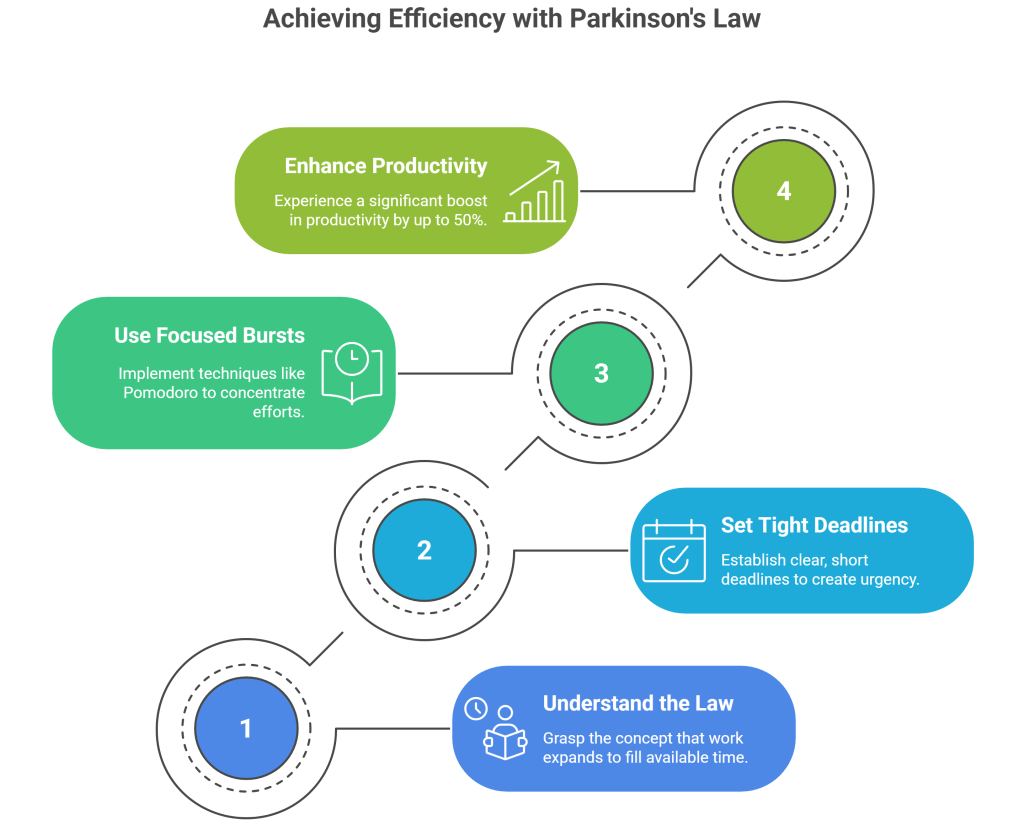
Description: Work expands to fill the time available, so set tight deadlines to increase urgency and efficiency. Use short, focused study bursts (e.g., 25-minute Pomodoros) to combat procrastination and perfectionism.
How It Works: Formulated by C. Northcote Parkinson in 1955, this law suggests tasks take as long as you allow. A 2025 Asana guide notes that shorter deadlines create productive pressure, while a 2023 Forbes article suggests it can boost productivity by up to 50%.
Evidence: Companies like Basecamp use short work cycles (e.g., Summer Hours) to enhance efficiency, as noted in a 2021 Clockify.me blog.
Example: Allocate 1 hour to review a chapter instead of an open-ended session. Use a timer to stay focused and move on once time is up.
Blurting Method
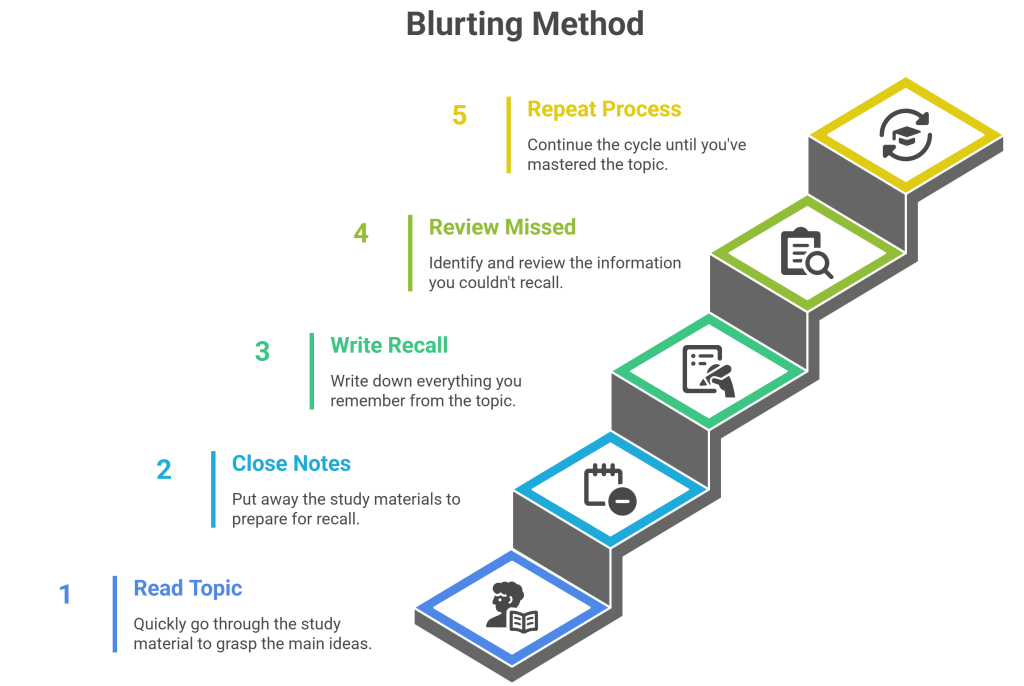
Description: Read a topic quickly, close your notes, write down everything you recall, review missed items, and repeat. This method excels at active recall, quick revision, and memory retention.
How It Works: By testing memory through active recall, you identify gaps and strengthen retention. A 2023 SchoolHabits.com blog recommends using it at the start and end of study sessions, while a 2024 Quizgecko.com article cites a 2017 Psychological Science study showing active recall boosts retention by 50%. Harvard research also notes 60% higher exam scores for students using active recall.
Evidence: The method’s flexibility makes it effective across subjects, as per a 2023 E-Student.org article.
Example: After reading about photosynthesis, close your notes and write down key points (e.g., “chlorophyll absorbs light”). Review missed details and repeat until mastered.
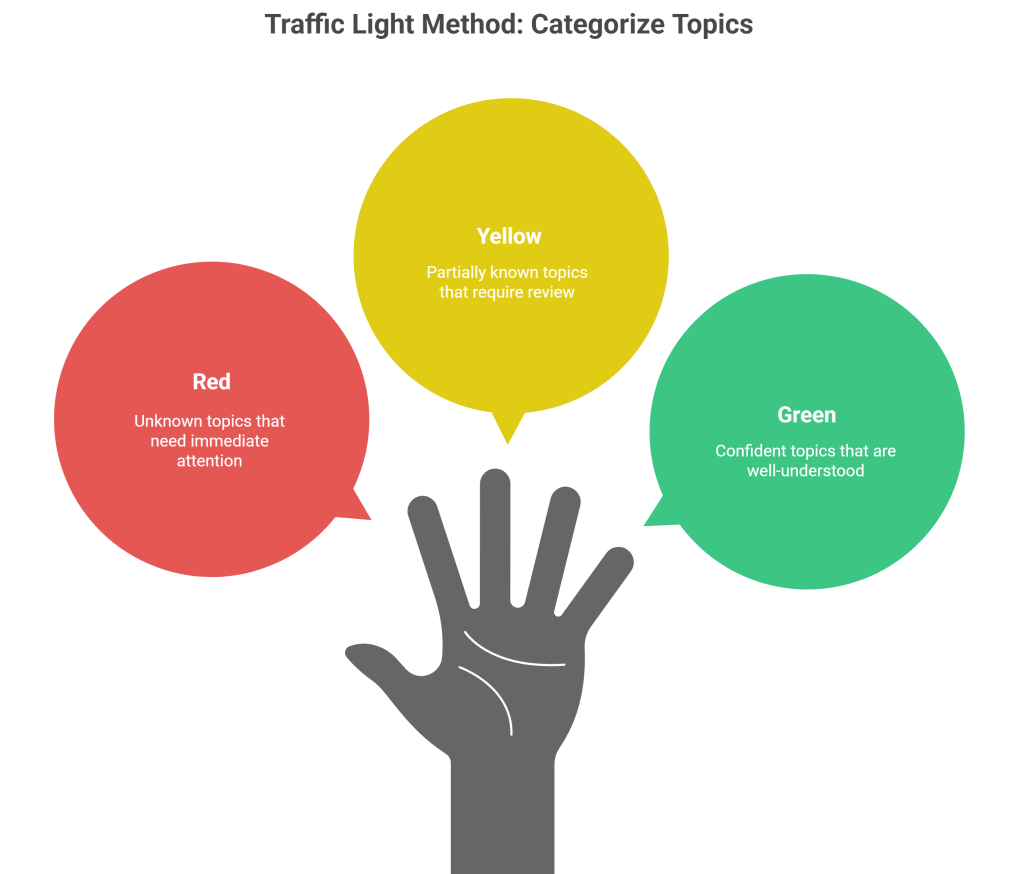
Description: Rate topics as red (unknown), yellow (partially known), or green (confident), prioritizing red and yellow for study. This method is ideal for self-assessment, revision planning, and focusing on weak areas.
How It Works: By categorizing topics, you focus on weaknesses first, optimizing study time. A 2022 Art of Smart guide suggests using syllabus points for categorization, while a 2024 Lern-Forum.ch article highlights its use in independent learning.
Evidence: Though research on its study application is limited, its use in classroom self-assessment is well-documented (The English Classroom, 2022).
Example: For a biology exam, mark “mitosis” as red if unknown, “photosynthesis” as yellow if partially understood, and “cell structure” as green if mastered. Study red and yellow topics first.
Take Your Studying to the Next Level
These six study techniques are proven to boost productivity, focus, and grades. Start with one or two methods that resonate with you, and track your progress over a week. Want to stay organized? Download our free study planner to apply these techniques and create a personalized study schedule. Share your favorite tip in the comments or on X to inspire others!
Further Reading: